Ever since the fall of the Berlin Wall, the countries of Central and Eastern Europe (CEE) that regained their independence have been receiving lessons from their western neighbours: they were told what to do in order to become responsible members of the European and transatlantic communities. This project reversed perspective, inviting us to find out what Western and Southern Europe can learn from CEE.
Politicians and analysts from CEE were the first to warn of the threat that Russia's authoritarian turn and revisionist imperialism posed to the Pax Europaea. After Russia's full-scale invasion of Ukraine in 2022, they were among the staunchest supporters of the Ukrainians in their fight for survival – and they still are today. They steadfastly point out that if Russia gets its way in Ukraine, we will not return to peace. We are likely to face new wars of conquest, both by the Putin regime and by autocrats elsewhere emboldened by the reluctance of democratic states to do what is necessary to defend each other and a rules-based international order. This grim prospect is drawing closer, now that the US government under Trump is siding with the Putin regime against Ukraine and Europe.
Greens and progressives should consider the defence of democracy as a core mission, not least because democracy offers the best chances for peace and a sustainable future. Today, Ukraine is the first line of defence. Many Green and progressive parties are indeed championing military, economic, and humanitarian aid to Ukraine. At the same time, however, parts of the green movement and the European Left are marred by an amoral strand of geopolitical ‘realism’ that assigns great powers rights over smaller states in their 'spheres of influence'. This implies that entire nations are denied the agency to democratically choose their future. This approach boils down to ‘might is right’.
For a robust alternative to great power realism, we should definitely look to CEE. Not to Viktor Orbán and other Putin cronies, of course, but to the friends of Ukraine. The most interesting ideas come from those voices that not only focus on Ukraine’s survival and their own nations’ security, but weave these goals into a broader narrative about a Europe that stands up for its values – in particular democracy, human rights, self-determination, and the (international) rule of law. These voices have been dubbed ‘neo-idealists’ by scholar Benjamin Tallis.
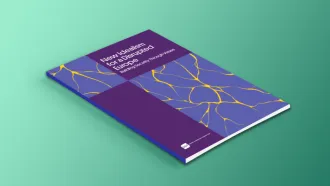
This project for the Green European Foundation has evaluated both strengths and weaknesses of the new idealism. The concept of ‘neo-idealism’ has been supplemented with green perspectives on global justice, planetary boundaries, and societal resilience. The findings were published in March 2026 in the report New Idealism for a Disrupted Europe - Building Security Through Values. It contains essays, interviews, and political recommendations.
The project New Idealism for a Disrupted Europe was carried out on behalf of the Green European Foundation (GEF) by Wetenschappelijk Bureau GroenLinks (NL), VONA (BE), Association for International Affairs (CZ), and Degrowth Estonia. It benefited from the financial support of the European Parliament to GEF.